Product life cycle assessments.
Beyond carbon.

Planetary Insights for Products is life cycle assessment software based on the Planetary Boundaries.

Model your supply chain, run assessments across 10 environmental impact categories, identify hotspots throughout your value chain, and communicate results with Planetary Facts — nutrition labels for the planet.

Coming soon - EDP-ready outputs and PEF results
Book a demo
Book a demo
What are Planetary Facts Labels?
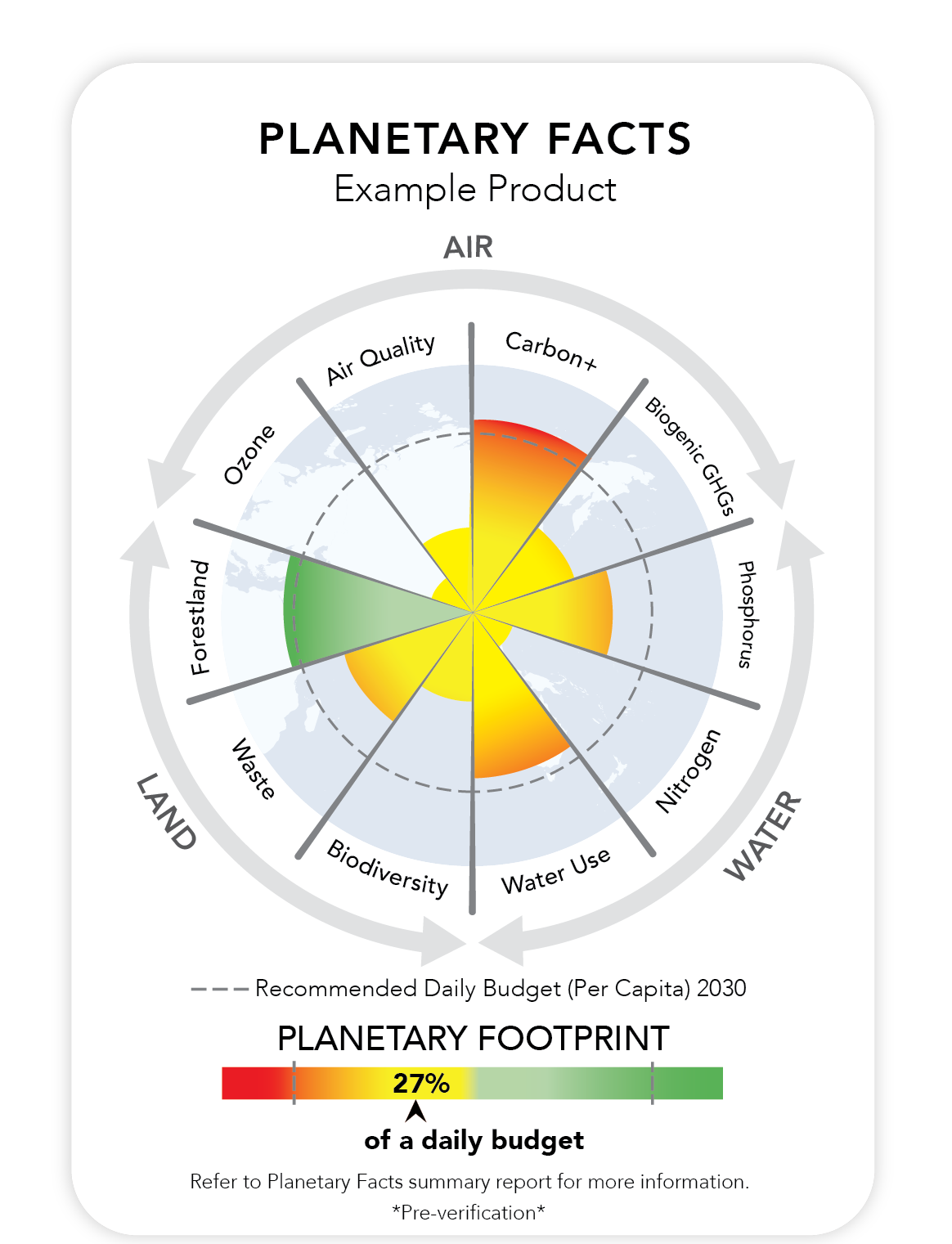
Planetary Facts labels show a product's full impact on nature - across all the Planetary Boundaries. Like nutrition facts show the overall energy content (calories), and nutrition data (e.g. protein, fat, and carbohydrates) as a proportion of a recommended daily intake; Planetary Facts show the overall planetary footprint, and each environmental footprint (carbon, water, waste, biodiversity, land-use and more) in context of a recommended daily budget.
including:
  • Holistic impacts on nature - from biodiversity to climate change, water, and waste
  • Consistent format - for meaningful product comparisons against any product category
  • Science-based context - founded in the Planetary Boundaries
  • Easy to communicate results - on-pack, in procurement submissions, and for customer and stakeholder engagement
Book a demo
Book a demo
LCA Hotspot Analsyis
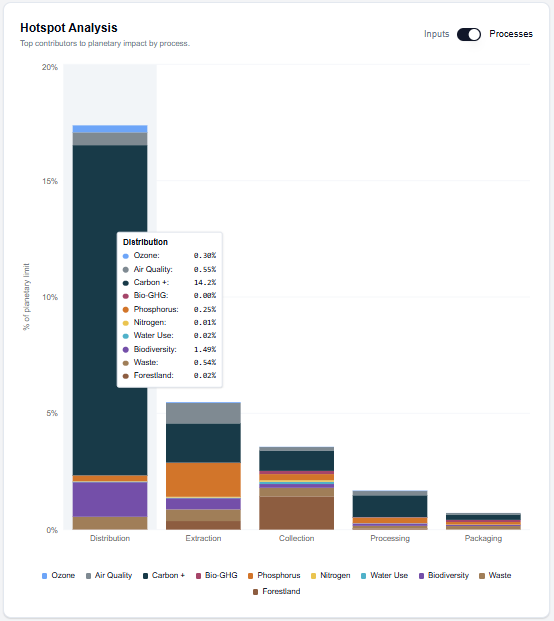
Planetary Insights for Products' hotspot analysis breaks down a product's life cycle assessment results by process, input material, supplier, or environmental impact category. Unlike carbon-only tools, it shows impacts across all 10 planetary accounts simultaneously — so you can see whether a material change that reduces carbon increases water stress or land use - and understand whether this tradeoff improves environmental performance overall or not.

Scenario modelling lets you test material swaps, supplier changes, and logistics alternatives before committing, with results updated across all impact categories in real time.
including:
  • Process-level impact breakdown - drill down by input material, process, or supplier to pinpoint environmental hotspots
  • Multi-boundary scenario modelling - test material swaps, new suppliers,  or alternative distribution solutions and see the impact on all 10 environmental footprints simultaneously
  • Side-by-side product comparison — compare design variants or alternative formulations before production decisions are made
  • Supports ESPR and CSRD reporting — provides the evidence base for product-level environmental performance claims under EU regulations
Book a demo
Book a demo
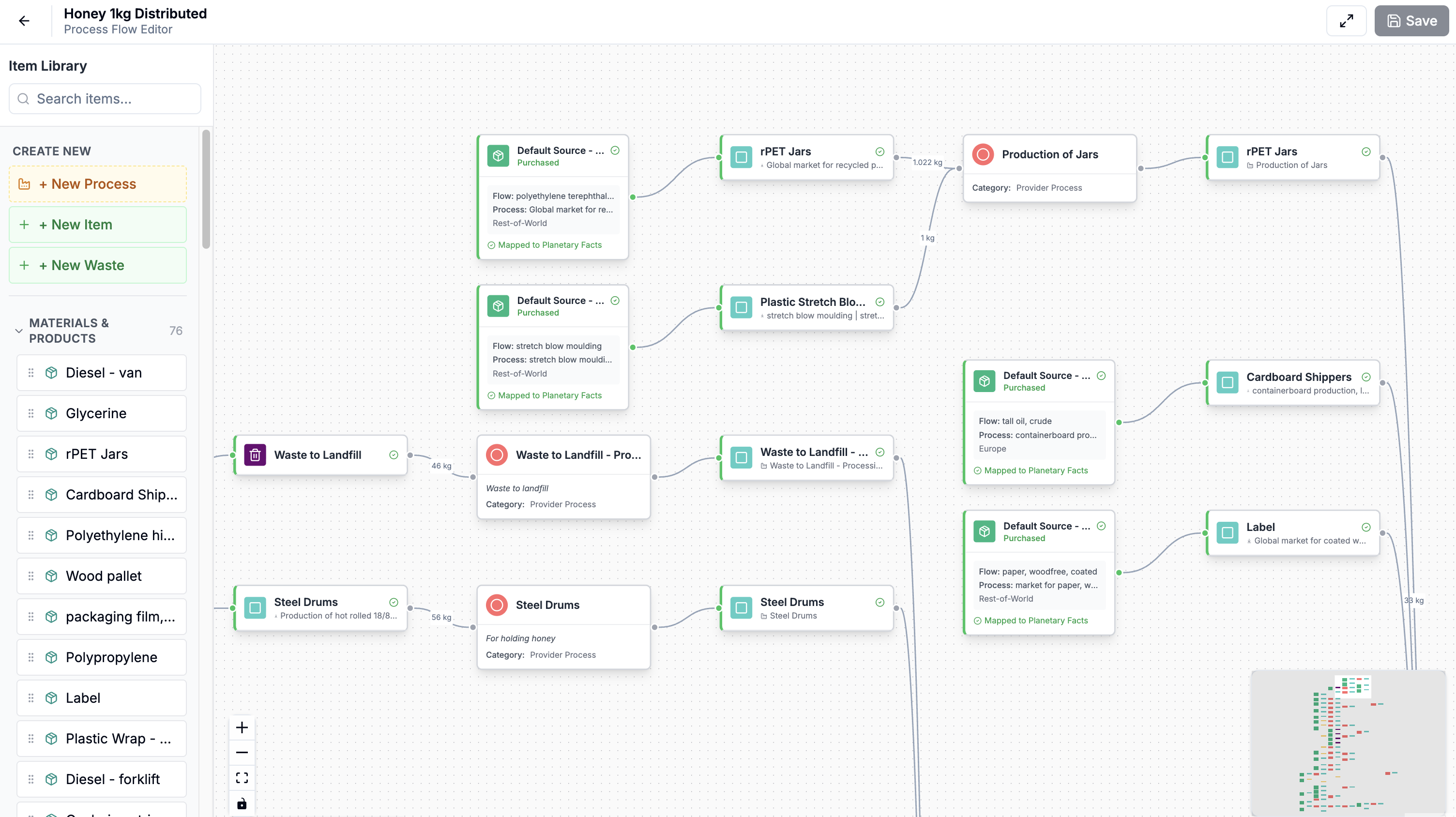
Process flow diagram for distributing 1kg of honey showing item library on left and interconnected nodes for sources, production of jars, steel drums, cardboard shippers, and waste to landfill.
Supply Chain Modelling
Planetary Insights' supply chain modelling tool enables you to build a complete product life cycle model using a visual process-flow builder. Map every input, output, co-product, and waste stream at each stage of production, from raw material extraction through manufacturing, distribution, use, and end of life. Background data sources are integrated directly into the platform, so you can begin your first life cycle assessment without sourcing data from external LCA databases.
including:
  • Visual process-flow builder - drag and drop mapping from cradle to gate or cradle to grave without specialist LCA expertise required
  • Multi-output process support — model co-products, by-products, and waste streams with correct allocation, in alignment with ISO 14040/44 methodology requirements
  • Multi-source impact mapping — attribute environmental impacts to specific suppliers or production periods, supporting supply chain transparency and procurement decisions
  • Integrated background LCA data — built-in background datasets reduce setup time and lower the barrier to a first assessment, compared with traditional LCA tools that require separate database subscriptions
Start now
Start now
Virtual Sustainability Team
Many businesses need life cycle assessments but don't have in-house LCA expertise. Planetary Insights solves this through a network of accredited Planetary Facts Practitioners — who build your full product LCA models directly inside the platform. Because the work is delivered into your Planetary Insights account, not a consultant's files, the models remain yours to update, reuse, and build on as your products evolve.
including:
  • Accredited Planetary Facts Practitioners — a vetted network of experts who can build product models on your behalf
  • Models delivered into your account — all LCA work is completed inside Planetary Insights and remains your asset — no consultant lock-in, no separate file management
  • Bundled, transparent pricing — no separate vendor management or consultant invoices; partner work is scoped and priced alongside your platform subscription
  • Full coverage, end to end — from data collection and process modelling through to Planetary Facts label generation. EPD-ready outputs, and PEF results coming soon
Talk to us
Talk to us
Person holding a glowing Earth globe showing illuminated city lights at night, focusing on Asia region.
common questions
We’re here to answer your questions.
What is a product LCA?
Chevron down icon
A product life cycle assessments (LCA) is a systematic analyses of a product's environmental impact from raw material extraction through production, use, and end of life. Planetary Insights is LCA software that automates data collection, impact calculation, and reporting. Results can be used to generate Environmental Product Declarations (EPDs), support Product Environmental Footprint (PEF) assessments, and meet regulatory requirements such as the EU Ecodesign for Sustainable Products Regulation (ESPR).
Contact us
Contact us
How is Planetary Insights different from other LCA software?
Chevron down icon
Most LCA software tools — including SimaPro, GaBi, One Click LCA, and OpenLCA — provide a set of environmental outputs that very difficult to interpret. While users may be able to quantify the carbon, water, and waste footprints of their products, they cannot use the results to determine which footprint is most material or whether to reduce one footprint at the cost of another.

Planetary Insights uses Planetary Accounting, a scientifically peer-reviewed framework, to show each impact relateive to another. This means users not only know the size of each impact, they can use the results to manage trade-offs meaningfully. Planetary Insights tells users when they should reduce carbon at the cost of waste and other impacts, and when they shouldn't.

Contact us
Contact us
Does Planetary Insights produce EPD outputs?
Chevron down icon
This functionality is coming soon. Planetary Insights is developing outputs aligned with EN 15804+A2, the primary standard for Environmental Product Declarations (EPDs) for construction and manufactured products. This means assessment results can be used as the basis for a formal EPD, reducing the additional work typically required to translate LCA results into a verified declaration.
Contact us
Contact us
Does Planetary Insights support Product Environmental Footprint (PEF) assessments?
Chevron down icon
This functionality is coming soon. Planetary Insights is developing support for the EU Product Environmental Footprint (PEF) methodology, which is the European Commission's standardised approach to assessing and communicating product environmental impacts. PEF results from Planetary Insights will help businesses meet requirements under EU sustainability regulations including ESPR and CSRD.
Contact us
Contact us
What is the Planetary Accounting Framework?
Chevron down icon
The Planetary Accounting Framework is a peer-reviewed scientific methodology that translates the Planetary Boundaries — the Earth system thresholds identified by scientists as safe limits for human activity — into quantitative budgets that can be allocated to individuals, organisations, and products. Planetary Insights is built on this framework, which means its assessments are grounded in established science.
Contact us
Contact us
Who uses Planetary Insights for product LCA?
Chevron down icon
Planetary Insights is used by sustainability managers, product development teams, and procurement professionals at manufacturers, brands, and consultancies who need to understand the full environmental footprint of their products — not just carbon. It is also used by businesses preparing for EPD requirements, EU ESPR compliance, CSRD product-level reporting, and customer sustainability disclosures.
Contact us
Contact us
Do I need LCA expertise to use Planetary Insights?
Chevron down icon
No. Planetary Insights' network of accredited Planetary Facts Practitioners can build product models on your behalf, delivered directly into your account. You can then analyse your results, update your assessments, and add different scenarios in-house. Planetary Insights is designed for use by sustainability and product teams without specialist LCA training. Tools such as our visual process-flow builder, integrated background data, and guided assessment workflow reduce technicals barriers significantly.
Contact us
Contact us
Where do the emission factors and background data come from?
Chevron down icon
Emissions factors and background data are pulled from ecoinvent, agribalyse, and other LCA datasets. We can also work with you to build adapted datasets that are specific to your supply chain.
Contact us
Contact us
How does the expert partner network work?
Chevron down icon
If you don't have in-house LCA and Planetary Accounting capability, our network of accredited practitioners - including the Planetary Accounting Network and independent specialists - can build your product models directly inside the platform. Fees are bundled into your engagement, so there's no separate procurement process. You own the models they create and can reuse, update, and extend them yourself.
Contact us
Contact us
How long does a product assessment take?
Chevron down icon
It depends on the complexity of your supply chain, but a straightforward product with 10–20 inputs can be modelled and assessed in a few hours. The process-flow builder is designed to remove the bottlenecks that make traditional LCA slow.
Contact us
Contact us
Can I import existing LCA data?
Chevron down icon
The platform supports standard LCA data formats and can integrate with existing databases. If you have prior assessments or supplier-provided data (e.g., EPDs), it can be incorporated into your models.
Contact us
Contact us
Can I import existing LCA data?
Chevron down icon
The platform supports standard LCA data formats and can integrate with existing databases. If you have prior assessments or supplier-provided data (e.g., EPDs), it can be incorporated into your models.
Contact us
Contact us
Can I import existing LCA data?
Chevron down icon
The platform supports standard LCA data formats and can integrate with existing databases. If you have prior assessments or supplier-provided data (e.g., EPDs), it can be incorporated into your models.
Contact us
Contact us
Can I import existing LCA data?
Chevron down icon
The platform supports standard LCA data formats and can integrate with existing databases. If you have prior assessments or supplier-provided data (e.g., EPDs), it can be incorporated into your models.
Contact us
Contact us
Where do the emission factors come from?
Chevron down icon
PI uses scientifically validated emission factor databases that cover thousands of materials, processes, and energy sources. Every factor is traceable to its source methodology, so your results are auditable.
Contact us
Contact us
What is the Planetary Accounting Framework?
Chevron down icon
The Planetary Accounting Framework is a peer-reviewed methodology developed by Dr Kate Meyer (our CEO) and Distinguished Professor Peter Newman that translates the Planetary Boundaries (Stockholm Resilience Centre) into quantified budgets applicable to products, organisations, and economies. It is stewarded by the Planetary Accounting Network, a New Zealand-based charitable trust.
Contact us
Contact us
What is the Planetary Accounting Framework?
Chevron down icon
The Planetary Accounting Framework is a peer-reviewed methodology developed by Dr Kate Meyer (our CEO) and Distinguished Professor Peter Newman that translates the Planetary Boundaries (Stockholm Resilience Centre) into quantified budgets applicable to products, organisations, and economies. It is stewarded by the Planetary Accounting Network, a New Zealand-based charitable trust.
Contact us
Contact us
What is the Planetary Accounting Framework?
Chevron down icon
The Planetary Accounting Framework is a peer-reviewed methodology developed by Dr Kate Meyer (our CEO) and Distinguished Professor Peter Newman that translates the Planetary Boundaries (Stockholm Resilience Centre) into quantified budgets applicable to products, organisations, and economies. It is stewarded by the Planetary Accounting Network, a New Zealand-based charitable trust.
Contact us
Contact us
What is the Planetary Accounting Framework?
Chevron down icon
The Planetary Accounting Framework is a peer-reviewed methodology developed by Dr Kate Meyer (our CEO) and Distinguished Professor Peter Newman that translates the Planetary Boundaries (Stockholm Resilience Centre) into quantified budgets applicable to products, organisations, and economies. It is stewarded by the Planetary Accounting Network, a New Zealand-based charitable trust.
Contact us
Contact us
“PI's really easy to pickup.”
Jo Woods
Director of Sustainability, Revolve Energy